Block-World Stories
Tell original short stories in a block-built world, with a readable environment, a recurring cast, and visible choices that change the scene.
Start with the viewer promise.
Make the setting part of the story. Let the character move, build, or share something visible to solve the problem.
Who it may suit Short-form viewers drawn to playful geometric worlds and small, emotional character choices.
Formats to try Shorts (9:16) · 30–60s
Make the channel distinct.
One neighborhood, many small problems
Return to a few recognizable landmarks and let small changes to the set accumulate across the series.
Ideas for your first episodes
Build a repeatable episode.
Plan the opening
Sketch the map and a small original cast.
Build the middle
Open with the obstacle and let the viewer see the attempt.
Finish the episode
End by showing what changed in the world.
Editable scene examples
Keep one action per clip. Use the camera and lighting cues as a starting point and change one setting per take so you can see what improved.
The missing step
Narration / character direction
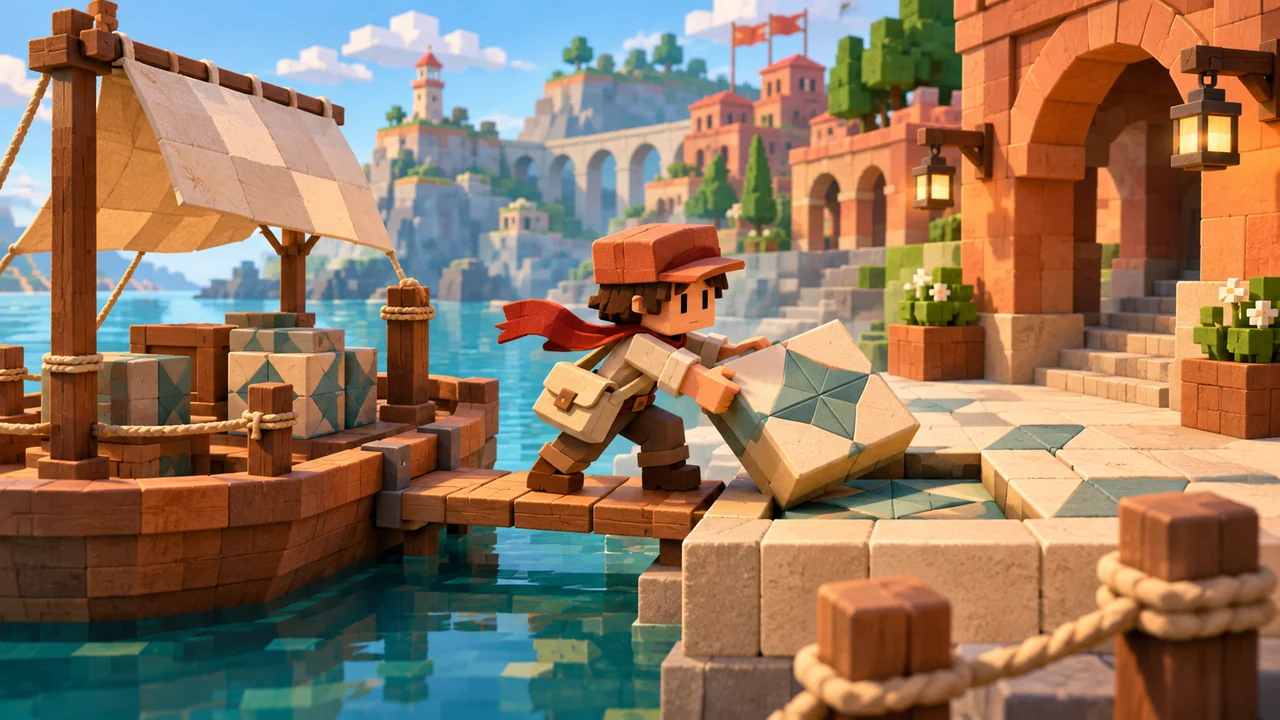
A lantern keeper with a square canvas satchel notices one missing tile between the landing and the ferry.
Image prompt
Original block-built harbor with asymmetrical wooden shapes, warm terracotta roofs, and blue-green water.
Motion prompt
Hold at dock level. The figure picks up a loose tile and slides it into the obvious gap.
Prompt library templates
Before you publish
- Maintain a stable visual grid across angles.
- Create your own textures, silhouettes, sounds, and interface art.
For factual content, keep a source record and verify the narration. For fictional scenes, make the presentation clear to your audience.
Common questions
How do I make the setting feel original?
Choose a distinctive architecture, color palette, and rule for how objects behave. Build your own landmarks and character shapes.