Plan a Mini-Documentary With a Chapter Outline
Shape a short documentary around a sequence of narrative sections, each with a purpose, evidence and handoff.
What you’ll take away
- Give each section one narrative job
- Attach evidence to the claim
- End with what remains unresolved
A mini-documentary outline is a sequence of content decisions, not a list of timestamps or a set of platform chapter markers. Each section should perform a job in the story: orient the viewer, raise a useful question, examine evidence, complicate the first explanation and close with an honest account of what is known.
Build the sequence around a question
Start with a question narrow enough to investigate within the available runtime. Write one sentence about what the video can establish and one about what it cannot. Then draft section cards rather than polished narration. A useful outline might move from context, to the central question, to evidence, to a complication and finally to a conclusion with limits.
For every card, note its purpose, the claim it needs to make, the source or scene that supports it and the handoff to the next section. If two cards do the same job, combine them. If a card introduces information that never matters again, remove it or explain its relevance. This makes the outline about the viewer's path through the subject, rather than a checklist of facts.
Let evidence shape the arc
Do not force records into a dramatic structure they cannot support. A complication can be a gap in the archive, a disagreement between accounts or a limitation in what the available evidence says. Name whose interpretation is being presented. Separate a source's direct observation from a later historian's explanation, and make the distinction clear in narration.
Fictional outline example
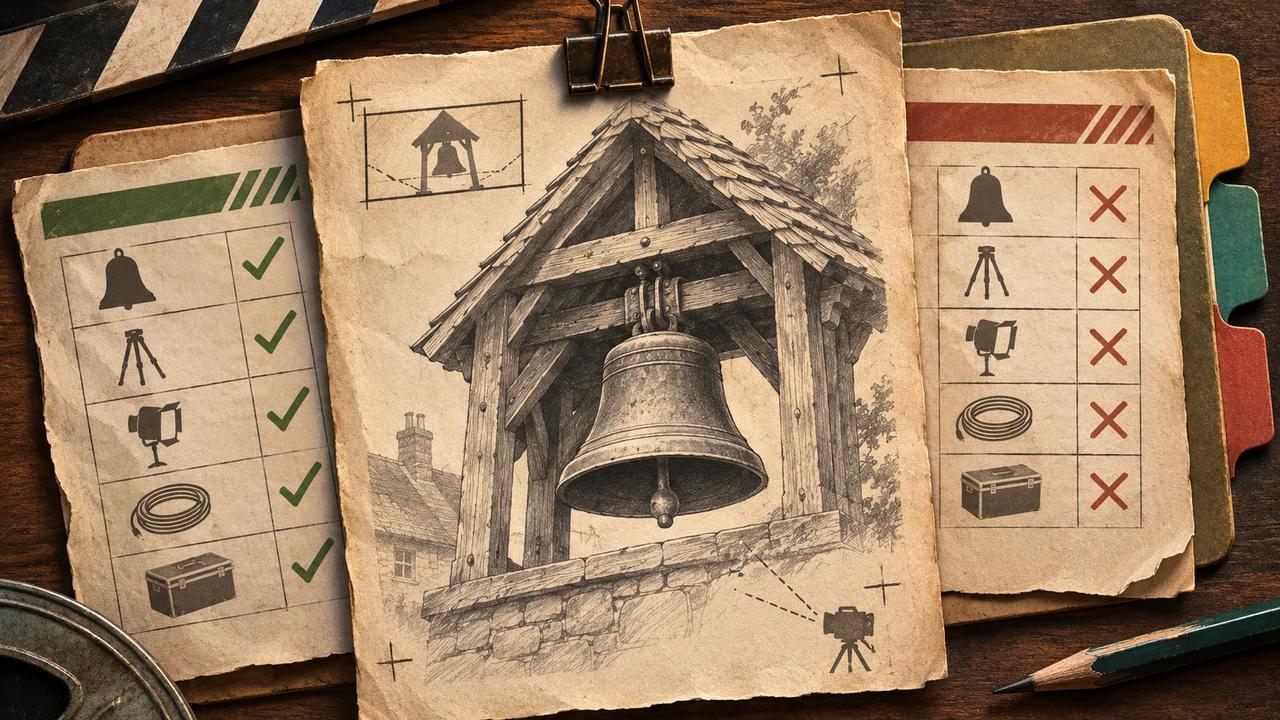
For a fully invented mini-documentary about a missing bell from a fictional village hall, the sections could be: introduce the bell and its role; state when it was last listed; compare two conflicting inventory notes; explain that neither record proves where it went; close by distinguishing the documented mystery from speculation. The village, bell and records are invented and do not describe an actual historical case.
The example shows how a useful ending can preserve uncertainty. It need not manufacture a culprit or a final revelation. During research, replace every invented placeholder with a checked source or remove it. If the evidence supports no answer, say so directly and explain what record might resolve the question.
Read the outline as a viewer
Before drafting, summarize each section in a short sentence. The sequence should make sense even without production notes. If the transition depends on a conclusion the prior section did not establish, add evidence or rewrite the handoff. For a compact process that connects research, scripting and editing, see the faceless content workflow.
Sources & further reading
Put it into practice
- A Repeatable Faceless Content Workflow: Idea to Published Video
- How to Build Content Pillars for a Faceless Channel